
Is UAD 3.6 the Last Straw? Why Some Appraisers Are Quitting (And Why You Shouldn't)
The conversations are happening in every appraisal Facebook group, every forum thread, every coffee shop between inspections.
"I'm done."
"It's not worth learning a new system at 62."
"Between AMC fees and now this? I'm hanging it up."
One appraiser on Facebook put the mood into words: "I have heard some real crazy numbers of appraisers quitting. One due to retirement, and two the 3.6 is 'forcing' people out."
After a decade of working with appraisers, I can tell you the sentiment is real. Some of the most experienced appraisers I know are seriously reconsidering whether this profession is still worth the effort.
And I understand the feeling. If you've been doing this for 25 years, you've watched fees compress, workload increase, AMCs take a bigger cut, and now someone's telling you to learn an entirely new reporting system eight months before it's mandatory.
At some point, "adapt again" starts to feel like "enough."
But before you make that decision, I want to show you what the exit of other appraisers actually means for the ones who stay.
The Numbers Nobody's Talking About
The appraiser workforce has been shrinking for nearly two decades. The profession peaked at about 98,450 appraisers in 2007. Today that number is roughly 78,800. That's a 20% decline in less than 20 years.
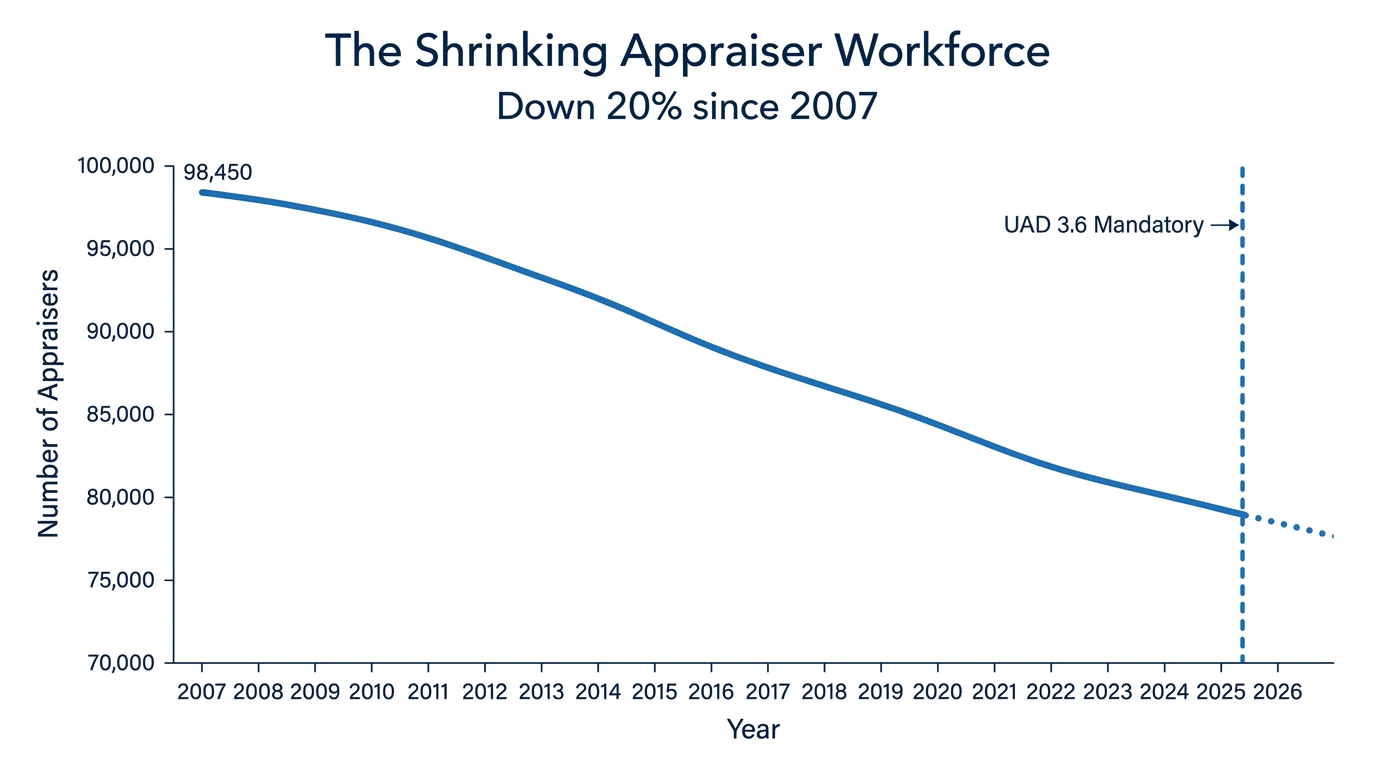
The age demographics make the trend even clearer. 75% of appraisers are over 40. More than 30% are over 60.
And now UAD 3.6 is accelerating the timeline. As one industry analysis noted: "Another significant fee factor is that many appraisers are retiring or quitting because they don't want to learn the UAD 3.6." (Appraisal Today)
Every appraiser who exits the market creates a small vacuum. Their orders go to someone else. Their AMC panel spots open up. Their private clients start looking for a new appraiser.
If you're one of the ones who stays, those vacuums are your opportunity.
The Supply and Demand Math
This isn't complicated economics. It's arithmetic.
Fewer appraisers plus steady demand equals upward pressure on fees and more available work. The same logic one industry blogger laid out clearly: "If reports take longer to complete, one of three things must happen: Appraisers produce fewer reports, fees increase to offset time, or quality compresses under volume pressure." (Kenney Appraisal)
The third option - quality compression - isn't sustainable. Which means the market moves toward fewer reports per appraiser and higher fees. Both benefit the appraisers who remain.
This dynamic has already been playing out slowly for years. UAD 3.6 is accelerating it. The November 2026 deadline is a forcing function that will push a measurable number of appraisers into retirement in the second half of this year. That's unfortunate for the profession - and it's an opportunity for the ones who adapt.
"I'm Too Close to Retirement for This"
This is the objection I hear most often when UAD 3.6 comes up with experienced appraisers. "I've got five years left. Maybe three. Why would I invest time learning a new system when I'm almost done?"
I hear you. And I want to push back gently.
If you have three to five years left, you have two options. You can spend those years doing the same AMC work at the same compressed fees, now with a more complicated reporting process. Or you can use this transition as the catalyst to build something more valuable.
What if you shifted your client mix so that a meaningful portion of your work came from estate attorneys and divorce lawyers at $600-$1,000 per assignment, where UAD 3.6 doesn't even apply?
And here's the part that matters most if retirement is on your mind: an appraisal practice with a diversified client base and organized systems is worth something when you sell it. A practice that's 80% AMC-dependent with no systems and no transferable client relationships? That's just a job that ends when you stop showing up.
Building value into your practice over the next 3-5 years isn't just about making more money today. It's about having something to sell - or hand off - when you're ready to stop.
I wrote more about this in Is Your Appraisal Practice Worth Anything? How to Build Sellable Value.
The Appraisers Who Will Thrive Through This
After watching hundreds of appraisers navigate industry changes over the years, I can tell you there's a pattern. The ones who come out ahead aren't necessarily the youngest, the most tech-savvy, or the most enthusiastic about change. They're the ones who do three things.
They start early. Not enthusiastically, not eagerly - just early. They grumble about the change like everyone else, but they open the new software, complete a mock report, and start getting familiar before the deadline forces them to. Starting two months early turns a crisis into a learning curve. Starting two weeks early turns a learning curve into a panic.
They diversify their revenue. They use the disruption as a wake-up call to build non-lender relationships. Not because they love marketing, but because the math becomes impossible to ignore when AMC reports start taking 50% longer at the same fee. Three estate attorney relationships can shift the economics of a practice faster than any fee negotiation with an AMC. (More on this in UAD 3.6 Doesn't Apply to Your Most Profitable Work.)
They build systems that work without them. The transition is hard enough without also fighting disorganized workflows. The appraisers with clean operations - orders tracked in one place, invoices going out automatically, routes optimized, mileage logged - spend their energy on the new reporting requirements. The ones running their practice off spreadsheets and sticky notes spend their energy on everything.
This is exactly what I built Appraiser Machine to solve. One system for orders, clients, routes, invoicing, and payroll - so the operational side of your practice doesn't compete with UAD 3.6 preparation for your limited bandwidth.
What "Hanging It Up" Actually Costs
If you're genuinely considering retirement because of UAD 3.6, I'm not going to tell you you're wrong. Only you know your financial situation, your energy level, and your appetite for one more round of adaptation.
But I want to make sure the calculation includes the opportunity cost.
The appraisers who retire in 2026 will exit the market at a moment when the supply-demand dynamics are about to shift in favor of those who remain. They'll leave before the fee adjustments that follow a contracting workforce. They'll leave before the non-lender work that's currently being overlooked gets captured by the appraisers who stay.
And if they haven't built a practice with transferable value - systems, client relationships, documented processes - they'll walk away with nothing to sell. The 25 years of expertise and reputation that could have been packaged into a sellable practice simply evaporates.
That might be fine. Not every career needs to end with a sale. But if you have the energy for three to five more years, those years could be your most profitable and your most valuable for building something transferable. The market conditions are aligning for it.
The Decision That Matters
UAD 3.6 isn't really the question. The question is whether you want to keep doing this - and if so, on what terms.
If the answer is "yes, but not like this" - not at $300 per AMC order, not at 80% lender dependency, not with five different tools to manage one practice - then this transition is your catalyst. Not because the new forms are exciting. Because the disruption creates the opening to rebuild your practice the way it should have been built years ago.
Better clients. Better fees. Better systems. And a practice that's worth something when you're ready to walk away.
The appraisers who are quitting right now are making room for the appraisers who refuse to. If you're one of the ones who stays, the next few years could be the best of your career.
But only if you start preparing now. The UAD 3.6 Checklist is the first step for the compliance side. Finding private clients is the first step for the revenue side.
Related Articles:
- How to Prepare for UAD 3.6 (Without the Panic)
- UAD 3.6 and Your Fees: Will You Actually Get Paid More?
- UAD 3.6 Doesn't Apply to Your Most Profitable Work
- Only 26% of Appraisers Feel Ready - Here's Why That's Good News
- Is Your Appraisal Practice Worth Anything?
- The Appraiser's Guide to Finding Private Clients

Jon Barrett
Jon Barrett is the founder of Appraiser Machine and has spent over a decade working with independent appraisers. He's built 300+ appraiser websites, co-led a national appraiser mastermind group, and talked with hundreds of appraisers about what's actually working in their practices. He built Appraiser Machine because the operations side of running an appraisal practice was still stuck in spreadsheets and duct tape - and appraisers deserved better.