

How to Prepare for UAD 3.6 (Without the Panic)
Here's what the industry conversation about UAD 3.6 sounds like right now: panic, confusion, and a growing number of appraisers quietly wondering if this is the thing that finally pushes them out.
I hear it every week. "I don't have time to learn a completely new system." "My software isn't even ready." "Maybe it's time to just hang it up."
One appraiser on Facebook put it plainly - they've heard "some real crazy numbers of appraisers quitting. One due to retirement, and two the 3.6 is 'forcing' people out."
And I get it. You've been using the same forms for 15 years. You've built a workflow that runs on muscle memory. And now someone's telling you to start over - with more data requirements, a new interface, and a deadline eight months away.
That's legitimately stressful. You're not overreacting.
But here's what I want to do in this article. First, I'll give you the practical path through the transition - not a 47-step plan, just the essentials. And then I'm going to share something most UAD 3.6 guides leave out entirely. A strategy that makes the whole transition less important to your bottom line.
The Fear Is Worse Than the Reality
Before we get into the steps, some perspective.
A survey of 300 appraisers found that only 26% feel well-prepared. 68% have done some training. 60% expect to need technical support during implementation. (Opteon survey)
If you're in the 74% who don't feel ready, you're in the majority.
But here's the counterweight: the first appraiser who actually submitted a live UAD 3.6 report described the process as "far easier than anticipated." (SFREP)
As the survey itself noted - this is "not a willingness problem. It's an enablement problem." The desire to prepare is there. What's been missing is a clear path.
Here's the path.
The Preparation Steps (Streamlined)
I wrote a detailed, step-by-step version of this in the UAD 3.6 Checklist for Appraisers - complete with software vendor status, training links, inspection workflow changes, and pre-submission verification items. If you want the full checklist, start there.
What follows is the condensed version. The seven things that matter most, in order.
1. Take the free training. Fannie Mae's "Industry's Guide to the New URAR" - 4 hours, free. Start here.
2. Update your report software. Confirm your version supports UAD 3.6. Install the update now, not the week before your first live order.
3. Complete one mock report. Pick a property you've already appraised. Open a blank UAD 3.6 report. Work through the whole thing. This single step prevents most of the first-day panic.
4. Update your inspection checklist. After the mock report, you'll know what data you're missing. Room-level detail, ceiling heights, energy features, disaster mitigation - add them to your field checklist. (Full details in the checklist article.)
5. Submit real UAD 3.6 reports during the dual-format period. We're in Broad Production now. Lenders can accept either format. Get 5-10 real submissions under your belt before November.
6. Have the fee conversation now. Reports take longer, at least initially. Talk to your AMCs and lenders about fees before November - not after. (Full fee analysis here.)
7. Start practicing this month. The appraisers who will struggle aren't the ones who lack ability. They're the ones who don't start until October.
That's the preparation path. Straightforward. Manageable. If you start now, you'll be ready by November with months to spare.
But here's the part of the conversation that I think matters even more.
The Strategy Nobody Else Is Talking About
Every UAD 3.6 article, webinar, and training course focuses on the same question: how do I adapt to the new system?
Almost nobody is asking the better question: how do I make the new system matter less to my income?
Here's the fact that changes the math on everything: UAD 3.6 only applies to loans sold to Fannie Mae and Freddie Mac. That's it. It's a GSE requirement for mortgage lending.
Non-lender appraisal work - estate planning, divorce valuations, tax appeals, bankruptcy, pre-listing appraisals, attorney-ordered work - does not require UAD-formatted reports. None of it. These assignments use narrative reports or GPAR forms and they are completely, entirely unaffected by this transition.
As the Appraisal Institute noted in February 2026: "With UAD 3.6 in the spotlight, non-lender residential appraisal opportunities can easily become overshadowed, despite continuing demand." (Appraisal Institute)
Now look at the fee comparison:
| Work Type | Typical Fee Range |
|---|---|
| Estate planning / probate | $500-800 |
| Divorce settlements | $600-1,000 |
| Tax appeals | $500-750 |
| Attorney work | $600-1,200 |
| Pre-listing | $400-600 |
| AMC lender work | $250-400 after AMC cut |
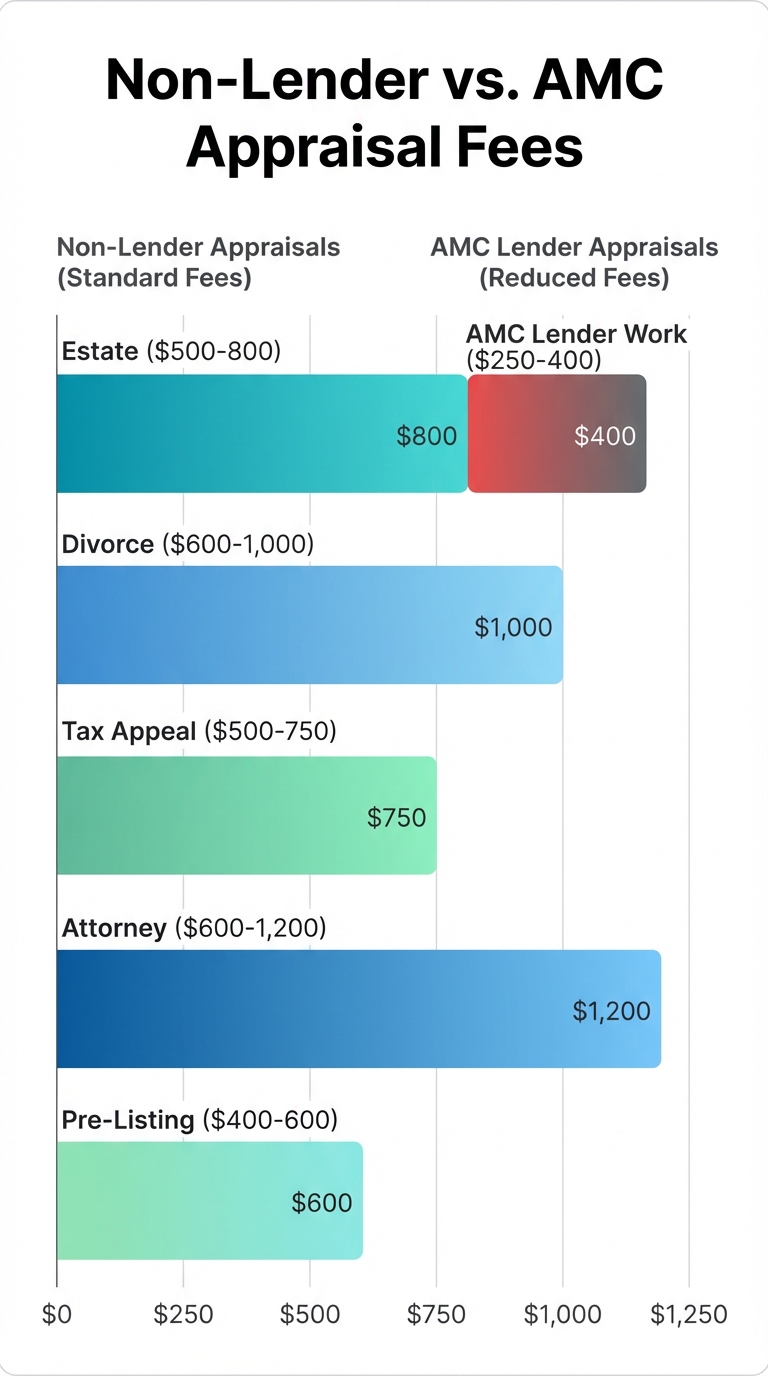
Read those numbers side by side and ask yourself: where should you be spending your preparation energy?
While most appraisers are scrambling to learn a new system for work that pays $300 through an AMC, the smartest appraisers I work with are building a client base of estate attorneys and divorce lawyers who pay double or triple that amount. And who don't care about UAD format at all.
Why This Moment Is Actually an Opportunity
Here's what's happening beneath the surface of the UAD 3.6 conversation.
Some appraisers are quitting. The Appraisal Today fee analysis notes that "many appraisers are retiring or quitting because they don't want to learn the UAD 3.6." (Appraisal Today)
The appraiser workforce has already declined from 98,450 in 2007 to roughly 78,800. 75% are over 40. 30% are over 60. And now a major regulatory change is accelerating the exit of appraisers who were already on the fence about retirement.
Fewer appraisers plus steady demand equals two things: upward pressure on fees for lender work, and more non-lender work available for those who position themselves to capture it. Estate attorneys, divorce lawyers, and CPAs need appraisers. If the appraiser they used to call retires, they're going to Google "estate appraiser near me" and call whoever shows up.
If that's you, the UAD 3.6 transition just became the best thing that happened to your practice. Not because of the new forms - because of the market shift happening around the new forms.
The Two-Path Strategy
This isn't an either/or decision. The appraisers who will thrive through this transition are the ones working both angles simultaneously.
Path A: Master UAD 3.6 for your lender work. Follow the preparation steps above. Get trained, get practiced, get comfortable. Reports will take longer initially, but you'll recover within a few months. Over 40% of appraisers expect fees to increase. Position yourself as one of the reliable, prepared appraisers lenders want to work with when November hits.
Path B: Build your non-lender practice in parallel. While you're spending time learning UAD 3.6 for the lender side, simultaneously build relationships with three to five estate attorneys, divorce lawyers, or CPAs in your area. These relationships take time to develop - start now, and by the time UAD 3.6 is mandatory, you'll have a growing stream of higher-paying work that doesn't require the new format at all.
Three relationships with local attorneys might do more for your income and your stress level than your fourth UAD 3.6 webinar.
I wrote a full deep-dive on the non-lender approach in UAD 3.6 Doesn't Apply to Your Most Profitable Work. And for the practical "how do I actually find these clients" guide, see The Appraiser's Guide to Finding Private Clients Who Pay 2x What AMCs Do.
The Honest Summary
UAD 3.6 is a significant change. The learning curve is real. The deadline isn't moving.
But this is also a profession full of people who learned TOTAL when it was new, who adapted to the original UAD in 2011, and who've survived every market cycle and regulatory shift the industry has thrown at them. You've been through harder things than a form change.
The difference between the appraisers who'll be fine in November and the ones who'll be stressed is whether they start now or wait. And the ones who come out of this transition in the strongest position aren't just the ones who mastered the new forms - they're the ones who used the transition as a wake-up call to stop depending on $300 AMC orders for 80% of their income.
You have eight months. That's enough time to be ready for UAD 3.6 AND to build the non-lender practice that makes it matter less.
Start with the checklist. Do one mock report this week. And seriously think about whether the smartest move you make this year has nothing to do with UAD 3.6 at all.
Related Articles:

Jon Barrett
Jon Barrett is the founder of Appraiser Machine and has spent over a decade working with independent appraisers. He's built 300+ appraiser websites, co-led a national appraiser mastermind group, and talked with hundreds of appraisers about what's actually working in their practices. He built Appraiser Machine because the operations side of running an appraisal practice was still stuck in spreadsheets and duct tape - and appraisers deserved better.