
UAD 3.6 Doesn't Apply to Your Most Profitable Work (And That Changes Everything)
Here's something nobody mentions at the UAD 3.6 webinars.
Estate appraisals don't require UAD format. Divorce appraisals don't require UAD format. Tax appeal appraisals don't require UAD format. Pre-listing appraisals, bankruptcy valuations, attorney-ordered work, private party appraisals - none of it.
UAD 3.6 is a GSE requirement for mortgage lending. That's it. If the appraisal isn't being submitted to Fannie Mae or Freddie Mac through UCDP, the new format doesn't apply.
And here's the part that should make you stop and think: those non-lender assignments are also the highest-paying work most residential appraisers can do.
The Fact That Reframes the Whole Conversation
Every article, every webinar, every CE course about UAD 3.6 is focused on the same thing: how to comply with the new reporting requirements for lender work. That makes sense. The mandate is real. The deadline is November 2, 2026. If you do lender work, you need to prepare.
But the industry conversation has become so consumed by UAD 3.6 that it's drowning out a strategic question worth asking: what would your practice look like if lender work wasn't 80% of your revenue?
An appraiser confirmed this plainly on AppraisersForum: "UAD is for lender assignments only." Another noted that reputable appraisers "would not use UAD ratings (C5, Q4) for a divorce appraisal." Non-lender work uses narrative reports, GPAR forms, or other formats based on the assignment requirements and USPAP - not UAD data standards.
The Appraisal Institute published a piece in February 2026 making this exact point: "With UAD 3.6 in the spotlight, non-lender residential appraisal opportunities can easily become overshadowed, despite continuing demand." (Appraisal Institute: Non-Lender Opportunities)
The demand for non-lender appraisal work hasn't paused because the industry is distracted by a form change. Estate attorneys still need date-of-death valuations. Divorce attorneys still need current market value for asset division. Tax appeal consultants still need independent valuations. These clients are looking for appraisers right now - and many of them are having trouble finding one.
The Fee Comparison That Nobody Wants to Talk About
I've shown this to hundreds of appraisers over the years. The reaction is always the same: a long pause followed by "I know. I know."
| Work Type | Typical Fee Range | UAD Required? |
|---|---|---|
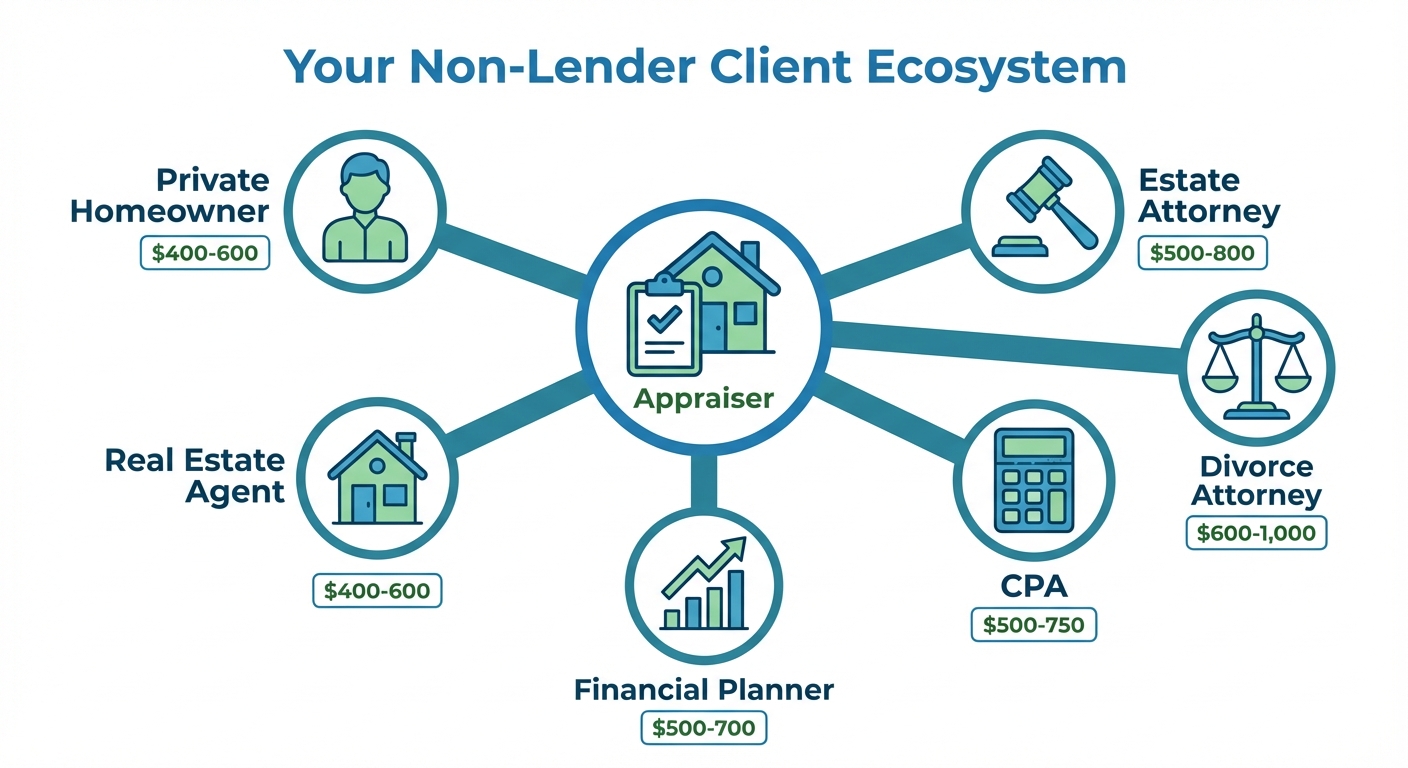
| Estate planning / probate | $500-800 | No |
| Divorce settlements | $600-1,000 | No |
| Tax appeals | $500-750 | No |
| Attorney work / expert witness | $600-1,200 | No |
| Pre-listing | $400-600 | No |
| Bankruptcy | $500-700 | No |
| AMC lender work | $250-400 after AMC cut | Yes |
You already know this. Every appraiser knows this. The question isn't whether non-lender work pays better. The question is why so much of many appraisers' work still comes from AMCs at compressed fees.
The answer, in most cases, is simple: nobody taught you how to find non-lender clients. You were trained to do appraisals, not to market yourself. And the AMC system makes it easy - orders show up in your inbox without you having to do anything. The fees are terrible, but the work is automatic.
Non-lender work pays more, but it requires you to be visible to the people who need you. Estate attorneys don't have an AMC that assigns you automatically. They Google "estate appraiser" in their area, or they ask a colleague for a recommendation. If you're not showing up in either of those places, the work goes to someone else.
What Non-Lender Work Actually Looks Like
For appraisers who've been doing primarily lender work for years, the non-lender side might feel unfamiliar. It doesn't have to be.
Estate and probate work is the most common entry point. An estate attorney needs a date-of-death valuation for a property in a probate case. The report is narrative-format, focused on what the property was worth on a specific past date. Turnaround is typically 5-7 business days. The attorney bills the estate, so payment is usually reliable. One good relationship with an estate attorney who handles 30-40 probate cases per year can generate 2-4 appraisals per month.
Divorce work is high-demand and often time-sensitive. Attorneys need current market value for marital asset division. Reports need to be court-ready and defensible. As one industry writer noted, "Divorce work is the most common, but attorneys also need valuation expertise for estate valuations, business disputes, tax litigation, bankruptcy proceedings, and expert witnesses." (Appraisal Buzz)
Tax appeal work is seasonal but lucrative. Property owners challenging their assessed values need independent appraisals. Appeal seasons vary by jurisdiction, but a single tax appeal consultant relationship can generate 10-20 appraisals during peak season.
Pre-listing appraisals are growing as homeowners seek independent valuations before listing. These are straightforward current market value reports, typically at $400-600 each.
Expert witness work is the premium tier. Attorneys retain appraisers as expert witnesses in litigation involving property values. This work bills hourly - often at $150-300/hour - in addition to the appraisal fee.
The common thread: higher fees, direct client relationships, repeat business potential, and no UAD formatting requirements.
How to Actually Find These Clients
This is where most appraisers get stuck. They hear about non-lender work, agree it sounds great, and then have no idea how to find it.
The good news: the client base for non-lender work is specific and reachable. These aren't random consumers. They're professionals who need appraisers regularly.
Estate attorneys are your highest-value target. Every attorney who handles probate cases needs an appraiser. They're searchable in your local bar association directory, through Google, and through your state's attorney listing. A simple professional introduction letter or email explaining your services is often all it takes. Estate attorneys want reliability, expertise, and court-ready documentation - not the lowest bid.
Divorce attorneys work similarly. Family law practitioners deal with property division constantly. They need appraisers who can turn reports around quickly and testify if needed.
CPAs and financial planners need appraisals for estate planning, trust administration, and net worth statements. These tend to be lower volume per client but are excellent long-term relationships.
The appraiser who shows up first with a professional presence - a real website, Google reviews, and a clear description of non-lender services - wins. Most markets have very little competition for this work because most appraisers have never marketed themselves for it.
This is one of the reasons we built prospecting tools directly into Appraiser Machine - search for estate attorneys, divorce lawyers, and CPAs in your area, get verified contact information, and start building those relationships without needing a marketing degree or a separate CRM.
I wrote a detailed step-by-step guide on this in The Appraiser's Guide to Finding Private Clients Who Pay 2x What AMCs Do.
Why This Moment Is the Best Time to Start
The UAD 3.6 transition creates a unique window for building your non-lender practice.
Appraisers are retiring. The workforce is shrinking. The appraisers who remain are consumed with UAD 3.6 preparation for their lender work. Meanwhile, estate attorneys and divorce lawyers still need appraisers - and they're finding fewer available ones.
If you invest time now in building relationships with three to five attorneys or CPAs in your area, you'll be capturing work that your competitors aren't even pursuing. Not because they don't want it - because they're distracted.
And here's the long-term play: non-lender relationships compound. An estate attorney who trusts you sends you every probate case. A divorce attorney who had a good experience refers you to colleagues. Within 6-12 months, a consistent effort to build non-lender clients can shift your practice from 80/20 AMC-dependent to 50/50 - or better.
The UAD 3.6 transition isn't just a compliance event. For appraisers who see it clearly, it's the push to build the practice they should have been building all along.
This Isn't Either/Or
I want to be clear: I'm not saying ignore UAD 3.6. If you do lender work, you need to prepare. The checklist and preparation guide are there for exactly that.
What I am saying is that the smartest response to UAD 3.6 isn't just compliance. It's diversification. Master the new format for your lender work AND build a client base where the format doesn't matter. That way, when November arrives, you're prepared on both fronts. And if lender work becomes less attractive over time - because of fees, because of regulatory burden, because of AMC headaches - you have somewhere to go.
The appraisers who will be in the strongest position five years from now aren't the ones who became the fastest UAD 3.6 report writers. They're the ones who used this moment to build a practice where no single client type, no single fee structure, and no single regulatory framework controls their income.
Related Articles:

Jon Barrett
Jon Barrett is the founder of Appraiser Machine and has spent over a decade working with independent appraisers. He's built 300+ appraiser websites, co-led a national appraiser mastermind group, and talked with hundreds of appraisers about what's actually working in their practices. He built Appraiser Machine because the operations side of running an appraisal practice was still stuck in spreadsheets and duct tape - and appraisers deserved better.