
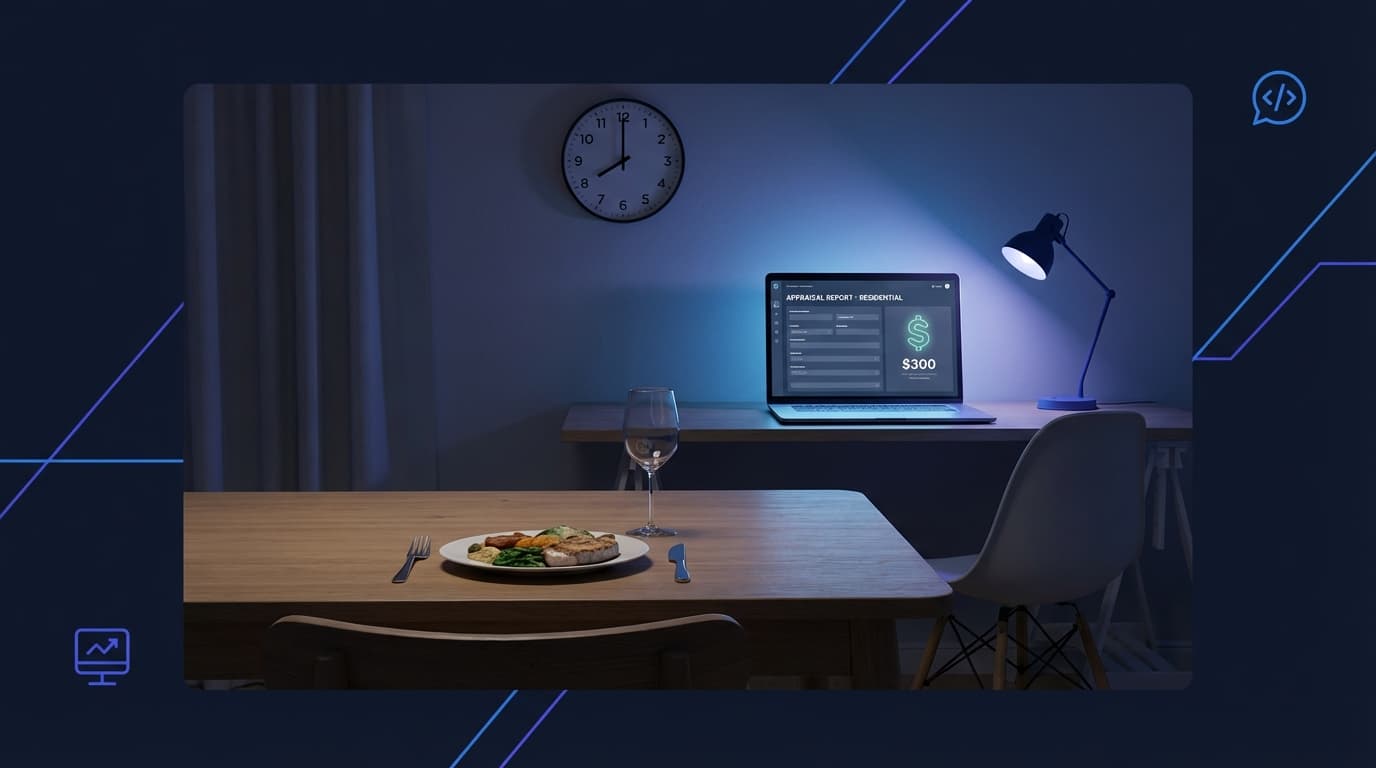
You Missed Another Dinner for a $300 Report
Your kid had a school event last Thursday. You were at your kitchen table writing a report narrative for an AMC assignment that pays $300.
Or maybe it wasn't last Thursday. Maybe it was the Saturday morning you spent in your truck finishing comp drive-bys instead of watching the soccer game. Maybe it was the vacation where you brought your laptop "just in case" and spent two of five days working from the hotel because three AMC orders came in and you couldn't say no. Maybe it was last night, when you promised you'd be done by 7 and finally closed the laptop at 9:30.
You know the specific moment. You've been carrying it.
The Trade You're Making
Here's something I don't hear discussed at appraiser conferences or in the forums: your practice is taking more from your family than you've admitted to yourself.
Not because you're a bad parent or a bad partner. Because the structure of your practice - the way it's built right now, today - requires you to be present for it to function. When the practice requires 50-55 hours a week of your presence, the math on what's left for everyone else is brutal.
There are 112 waking hours in a week. Subtract 50 for work (including drive time, inspections, and the report writing you do at the kitchen table after dinner). Subtract 10 for transitions - getting ready, commuting, the mental shift between "work mode" and "home mode" that takes longer than you think. Subtract 15 for basic personal maintenance.
That leaves 37 hours a week for your family, your health, your friendships, and yourself.
But those 37 hours aren't fully free. You're checking the AMC portal at the dinner table. You're thinking about the revision request during your kid's bedtime story. You're responding to "just one more email" while your spouse watches a show alone.
The real number - the hours where you're genuinely, fully present with the people who matter most - is probably closer to 15. Maybe less.
And you know this. You feel it every time your spouse gives you that look. The one that stopped being angry a long time ago and turned into something quieter: resignation.
"Things Will Slow Down After This"
The most dangerous lie in the appraisal business is "things will calm down after this."
After UAD 3.6 is implemented. After this busy season. After I clear the backlog. After I get through tax season.
You've been saying some version of this for years. And things haven't slowed down. They've sped up. Because a practice built on one person's constant involvement doesn't get easier as it grows. It gets hungrier.
Every new AMC panel adds to your plate. Every new client needs your attention. Every new regulatory requirement (hello, UAD 3.6) needs your preparation time. The practice scales its demands on your time faster than it scales your income.
The thing you built to give your family a better life became the thing keeping you from your family.
That's not a scheduling problem. It's a structural one. And "better time management" doesn't fix a structural problem.
The Math That Should Make You Angry
You stayed late last Tuesday to finish a report for an AMC that pays $300 after their cut. That report took 6 hours - let's say 2 hours of that was after the time you told your family you'd be done.
Those 2 hours of "overtime" earned you approximately $100 in marginal income (the last third of the report at $300 total divided across 6 hours).
Would you have paid $100 to be at dinner with your family that night? To help your kid with homework? To watch a show with your spouse without checking your phone?
Of course you would. But the trade doesn't feel like a choice when you're in it. It feels like an obligation. "I have to finish this report." "The deadline is tomorrow." "I can't fall behind."
The question isn't whether the report needed to be finished. It's whether a practice that regularly forces you to choose between a $300 report and dinner with your family is a practice worth running in its current form.
The Fix Isn't Working Less
"Set boundaries." "Learn to say no." "Batch your tasks."
You've heard the advice. You've tried some of it. It worked for about two weeks before a client emergency pulled you back into the old pattern.
Here's why: most work-life balance advice treats the symptom (you're working too much) without addressing the cause (your practice can't function without you working too much). Telling an appraiser whose practice depends on them for every task to "set boundaries" is like telling someone to bail water faster instead of fixing the hole.
The fix isn't about managing your time better. It's about building a practice that doesn't need all of your time.
That means systems that handle the operational work without your manual effort. Order tracking that doesn't live in email. Invoicing that happens automatically at delivery instead of "when you get to it" at 10 PM. Route optimization that cuts out the unnecessary driving you do every inspection day. Mileage tracking that runs in the background instead of requiring a spreadsheet entry every evening.
Every hour of operational overhead that a system handles is an hour you reclaim. Not for more AMC reports. For the parts of your life that the practice has been consuming.
What This Actually Looks Like
I worked with an appraiser who was a classic case of the 50+ hour week. Everything manual. Everything in her head. She was the order tracker, the scheduler, the invoice sender, the mileage logger, the route planner, and the report writer - all in one person.
After moving her operational workflows into one system, she freed up hours she'd been spending on manual admin. She used that time differently. Some went to building estate attorney relationships (which now generate higher-paying work with better hours). Some went to UAD 3.6 preparation. And some — the ones that mattered most — went home.
She told me later that the biggest change wasn't the revenue. It was that she stopped working after dinner.
That's the shift. Not "work less." Build a practice that doesn't need your evenings.
The Uncomfortable Question
If you're 5-10 years from retirement, consider this: you built this practice to provide for your family. But what if the practice you built is the thing preventing you from being present for them?
Twenty-five years of missed dinners, late nights at the kitchen table, and vacations interrupted by AMC orders. For $300 per report with a 45-day payment cycle.
The appraisers who escape this pattern don't do it by finding more hours. They do it by building practices with systems that run the operations, fee structures that pay what the work is worth, and client relationships that don't require an AMC middleman.
They build practices where the 50-hour week becomes a 40-hour week. Where the 40-hour week becomes a 35-hour week. Where the evenings belong to the family, not the AMC portal.
That's not a fantasy. It's a structural change. And it starts with honestly answering one question: what am I trading tonight for a $300 report?
If the answer makes you uncomfortable, the practice needs to change. Not tomorrow. Not "after this busy season." Now.
Start with the systems that eliminate the operational overhead. Then build the client base that pays what your time is actually worth. Then watch what happens when your evenings come back.
Related Articles:

Jon Barrett
Jon Barrett is the founder of Appraiser Machine and has spent over a decade working with independent appraisers. He's built 300+ appraiser websites, co-led a national appraiser mastermind group, and talked with hundreds of appraisers about what's actually working in their practices. He built Appraiser Machine because the operations side of running an appraisal practice was still stuck in spreadsheets and duct tape - and appraisers deserved better.