How to Track AMC Bids and Know Which Clients Are Actually Worth It
You're on four AMC panels. Maybe six. Orders come in. You accept the ones you can fit. You decline the ones that are too far or too cheap. At the end of the month, you know roughly what you made.
But here's the question you probably can't answer: which AMCs are actually profitable for you?
Not which ones pay the highest fee per order. Which ones are profitable after you account for drive distance, payment timing, revision frequency, and the turn time pressure they put on you.
AMC A pays $375 per order but the properties are scattered across a 60-mile radius, they pay in 55 days, and they send revision requests on 40% of reports. AMC B pays $325 per order but the properties are all within 20 miles of your home, they pay in 28 days, and they send revision requests on 10% of reports.
Which one is actually worth more to your practice? If you're like most appraisers, you don't know. Because you've never tracked the data needed to answer the question.
The Data You're Not Tracking
Most appraisers track two things about their AMC relationships: fee per order and approximate volume. That's enough to know who's paying you and roughly how much. It's not enough to know who's worth your time.
The data that actually determines AMC profitability:
Average drive distance per order. An AMC that sends you properties 40 miles away at $375 is paying you less per hour than one that sends you properties 15 miles away at $325. Drive time is unpaid labor and unreimbursed expense (beyond the mileage deduction). It's the hidden cost that makes "higher fee" AMCs less profitable than they appear.
Average payment timeline. The difference between getting paid in 28 days and 55 days isn't just cash flow annoyance. It's the cost of capital. That $375 sitting unpaid for 55 days while you need gas money and QuickBooks subscription fees is money you can't use. Over a year, the AMC that pays in 28 days puts thousands of dollars in your hands weeks sooner.
Revision request rate. Every revision request costs you time. A straightforward revision takes 20-30 minutes. A contested one takes an hour or more plus the emotional drain. If one AMC sends revisions on 10% of reports and another sends them on 40%, the second AMC is adding significant unpaid labor to every batch of orders.
Turn time pressure. Some AMCs give you 7-10 business days. Others pressure for 3-5. Tighter turn times mean less scheduling flexibility, more rushed inspections, and more evening report writing. The fee might be the same, but the work-life cost is different.
Acceptance rate on bids. If you bid on 10 orders from AMC C and they only accept 3, you're spending time evaluating and bidding on orders you don't get. That bidding time has no return. An AMC that sends you direct assignments (no bidding) is operationally cheaper than one requiring competitive bids for every order.
The AMC You Should Drop (But Haven't)
Every appraiser I work with has at least one AMC relationship that's costing them money when the full picture is considered. Not losing money on paper - the fee is positive. But when you add the 45-mile drives, the 55-day payment cycle, the revision requests, and the 4-day turn time pressure, the effective hourly rate on those orders is below what your time is worth.
You haven't dropped them because you never ran the math. You accepted those orders because they showed up in your inbox and accepting orders is what you do. The absence of tracking data means the decision to keep working with that AMC was never really a decision. It was a default.
Consider this scenario: your "best" AMC (highest fee per order) sends properties 35-50 miles from your home base. You're spending 2+ hours in the car per order, making your effective hourly rate lower than the AMC that pays $50 less per order but sends properties within 15 miles. Without tracking the data, you'd never know you're prioritizing the wrong relationship. Once you see the numbers, the strategic shift is obvious: accept every order from the closer AMC first, and only fill remaining capacity with the longer-distance one.
What Tracking Looks Like in Practice
You don't need a complex analytics system to start. You need four data points captured per order, consistently:
1. Fee. What you were paid (after any AMC cut).
2. Total miles. Round-trip from your home base to the property. Your route optimizer or mileage tracker should capture this automatically if you're using one. (If you're not tracking mileage, start here.)
3. Total hours. From accepting the order to delivering the report. Include drive time, inspection time, and report writing time. Don't be precise to the minute - an honest estimate to the half-hour is enough.
4. Days to payment. From delivery date to payment received date.
With those four data points per order, you can calculate effective hourly rate per AMC (fee divided by total hours), effective rate per mile, and average payment cycle. Run the numbers quarterly. The results will surprise you.
The Quarterly Client Review
Once you have three months of data, sit down for 30 minutes and answer three questions:
Which AMC has the highest effective hourly rate? Not the highest fee. The highest fee divided by total hours including drive time. This is your most profitable relationship. Protect it. Accept every order they send.
Which AMC has the lowest effective hourly rate? This is the one you should either renegotiate with or drop. If the effective rate is below $50/hour, you're better off spending that time marketing for private clients at $100+/hour.
Which AMC pays the slowest? If one AMC consistently takes 50-60 days while others pay in 25-30, that's worth factoring into your decisions. Slow payment isn't just annoying - it affects your cash flow and your ability to invest in your practice.
These questions sound basic. But most appraisers have never asked them with real data. They've operated on gut feelings about which AMCs are "good" and which are "bad" without the numbers to confirm. The numbers often contradict the gut.
From Tracking to Strategy
Once you see the data, the strategic decisions become obvious.
The most profitable AMC gets priority on your schedule. When their orders conflict with a lower-paying AMC's orders, you know which one to choose.
The least profitable AMC gets a conversation. "I need to adjust my fee to $X to continue accepting orders in your coverage area." If they agree, the relationship improves. If they don't, you free up time for better-paying work.
And the data feeds into your broader diversification strategy. If your best AMC produces an effective rate of $65/hour and estate work produces $100/hour, the argument for building non-lender clients isn't theoretical anymore. It's a documented gap that gets wider with every order you track. (Full diversification strategy here.)
How Appraiser Machine Makes This Automatic
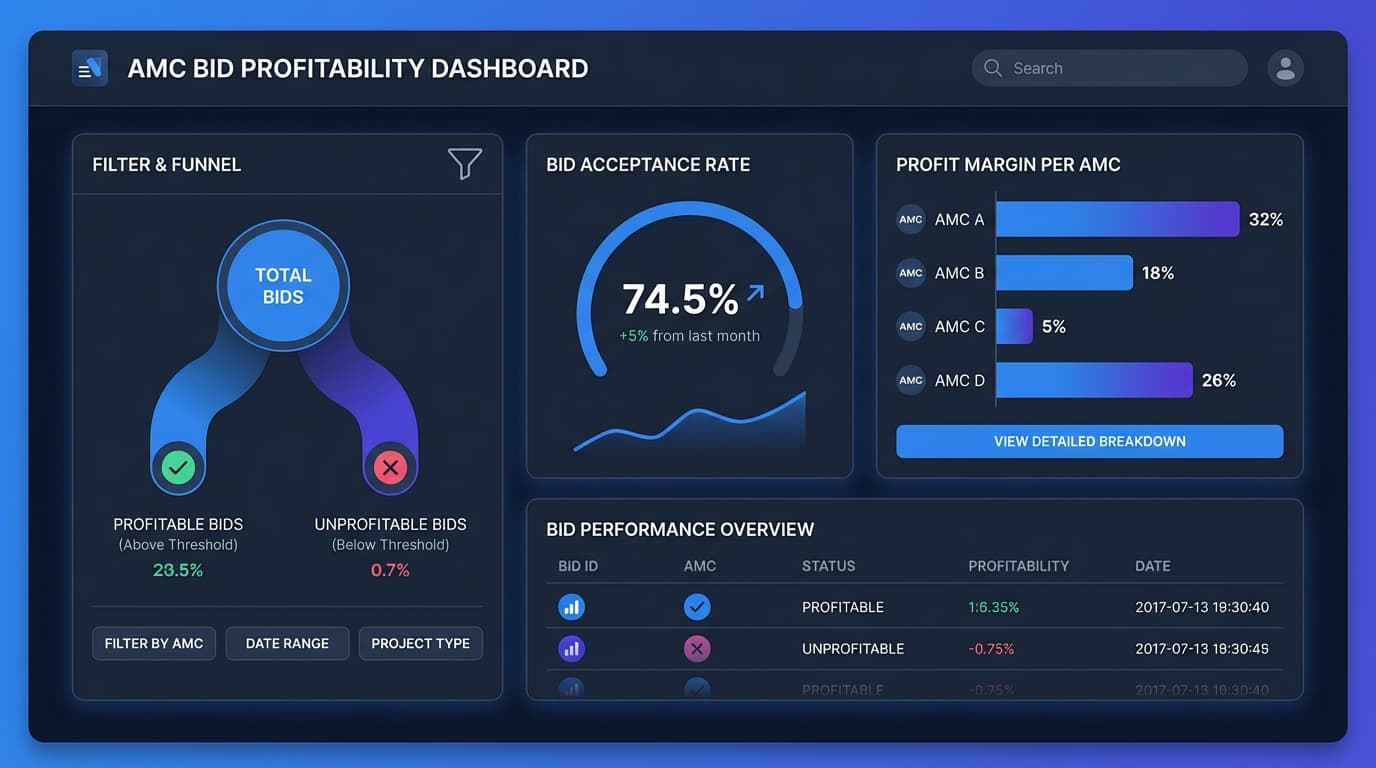
Inside Appraiser Machine, every order captures the data points described above as part of the normal workflow. The order records the fee. The route optimizer logs the miles. The order timeline tracks days from acceptance to delivery to payment. The dashboard aggregates it by client.
You don't run a separate analysis. You open your dashboard and see: revenue by client, average turn time by client, average fee by client, and payment timeline by client.
Appraisers who track this data are equipped to make different decisions. They say no to unprofitable orders instead of accepting everything. They negotiate from data instead of from feelings. And over time, their client mix shifts toward the relationships that actually compensate them fairly.
That shift - from accepting every order to strategically managing your client base - is one of the differences between running a practice and being run by one.
Related Articles:

Jon Barrett
Jon Barrett is the founder of Appraiser Machine and has spent over a decade working with independent appraisers. He's built 300+ appraiser websites, co-led a national appraiser mastermind group, and talked with hundreds of appraisers about what's actually working in their practices. He built Appraiser Machine because the operations side of running an appraisal practice was still stuck in spreadsheets and duct tape - and appraisers deserved better.