Route Planning for Appraisers: Plan Smarter Inspection Days
Your truck is your office. You spend more time behind the wheel than you do at your desk. And yet most appraisers plan their inspection routes the same way they did 15 years ago - by looking at addresses, opening Google Maps, and winging it.
You've got three inspections today. One is north, one is south, one is east. You start with whichever one has the earliest appointment window, drive to the next closest, then backtrack to the third. By the time you get home, you've driven 95 miles in a pattern that a route optimizer would have covered in 60.
That's 35 miles of unnecessary driving. About 45 minutes of wasted time. One day. No big deal.
Except it happens every inspection day. And over a year, it adds up to something that should make you angry.
The Math Nobody Does
A Caliper case study on municipal property inspectors — similar work pattern to appraisers (multiple stops, varying appointment windows, time-sensitive schedules) — found efficiency gains of approximately 50% compared to unplanned routing. Appraisal routing won't be identical, but the principle holds: optimized sequencing consistently beats gut-level planning.
Across 200+ inspection days per year, even small routing gains add up. That's time you could use for report writing, building non-lender relationships, or simply getting home earlier. (The 90-Day Plan only requires 4 hours per week.)
Why Google Maps Doesn't Cut It
Google Maps is great for getting from A to B. It's terrible for multi-stop route optimization.
Google Maps accepts up to 10 stops, but it routes them in the order you entered them - it doesn't optimize the sequence. You enter Inspection A, then B, then C, and it gives you the route A→B→C. It doesn't tell you that B→C→A would be shorter.
To optimize manually, you'd need to test every possible sequence. Three stops have 6 possible orders. Four stops have 24. Five stops have 120. Nobody's running 120 route permutations in Google Maps before their first inspection.
And Google Maps doesn't know about your appointment windows. Your 10 AM inspection has a firm time. Your afternoon inspections are flexible. A proper route optimizer accounts for fixed appointment times and arranges the flexible stops around them. Google Maps treats every stop equally.
What most appraisers actually do: look at the addresses, make a gut-level judgment about the order, and drive. It feels efficient because you're making a decision quickly. But quick decisions based on intuition are consistently 20-40% less efficient than optimized routing. Over a year, that gap is enormous.
The Dual Benefit Nobody Mentions
Here's something that changes the ROI calculation completely: a route optimizer that also tracks mileage solves two problems with one feature.
Most appraisers have a mileage tracking problem. They're either not tracking at all (leaving $8,700+ in deductions on the table), tracking inconsistently, or reconstructing from memory at tax time. (Full mileage analysis here.)
When your route planner logs every mile automatically as you drive - tied to the specific inspection order, at the current IRS rate - the mileage tracking problem disappears. You don't need a separate app. You don't need a paper log. The same system that plans your route also documents your deductions. By the time tax season arrives, the records are already compiled.
This is how route planning works inside Appraiser Machine. One click imports your day's inspections. The optimizer finds the fastest sequence accounting for real-time traffic and appointment windows. "Text My Route" sends every stop to your phone for one-tap Google Maps navigation. And every mile is logged automatically at $0.725/mile with the business purpose already recorded - because it's attached to the order.
Two problems. One feature. Zero manual tracking.
What Optimized Days Actually Look Like
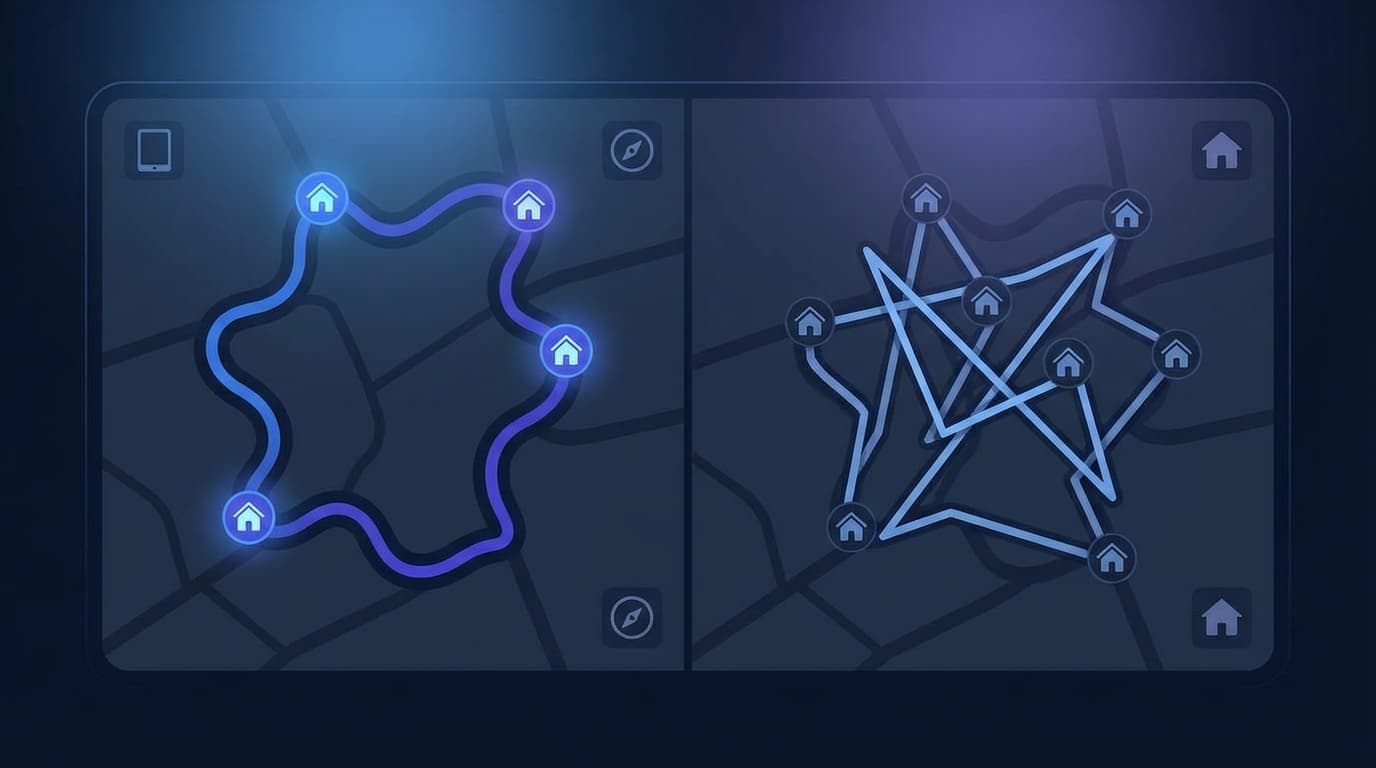
Picture a Tuesday with 4 inspections, unoptimized vs. optimized.
Unoptimized: You start with the earliest appointment north of home, backtrack past home to the second stop southeast, head west for the third, and backtrack again to the fourth in the northeast.
Optimized: You start with the stop closest to home, keep working in one direction, and finish with the stop nearest home.
Same four inspections. Same quality of work. Less backtracking and fewer miles.
And the mileage was logged automatically for both routes - but the optimized route also costs less in gas, less in vehicle wear, and generates a smaller tax deduction (because you drove fewer miles). The net financial impact of the shorter route is still positive even though the deduction is smaller.
The Scheduling Conflict Nobody Sees Coming
Here's a scenario that happens more often than appraisers admit: you accept a 10:00 AM inspection 40 miles from your first appointment, which ends at 9:30. You assumed 30 minutes was enough drive time. It isn't - there's construction on the highway you didn't know about. You arrive at 10:15. The homeowner is annoyed. You're flustered. The inspection starts off on the wrong foot.
A route optimizer with scheduling conflict detection catches this before you leave the house. "Warning: your 10:00 appointment is 42 minutes from your 9:30 completion. With current traffic, arrival would be 10:12. Adjust the sequence or the appointment time."
That warning - before you're already driving - saves the relationship with the homeowner, eliminates the stress of running late, and prevents the cascading delays that mess up the rest of your day.
Start This Week
You don't need to overhaul your entire workflow to start driving less. Here's the minimum effective change:
Tomorrow morning, before you leave the house, enter your day's inspection addresses into a route optimizer (any route optimizer - there are free options) and see what sequence it recommends. Compare it to the order you would have driven.
The first time you see how far your gut-level route is from the optimized route, the case is made. You'll never plan routes in your head again.
For the comprehensive approach - route optimization, scheduling conflict detection, automatic mileage logging, and one-tap phone navigation all tied to your orders - that's the route planning feature inside Appraiser Machine.
Related Articles:

Jon Barrett
Jon Barrett is the founder of Appraiser Machine and has spent over a decade working with independent appraisers. He's built 300+ appraiser websites, co-led a national appraiser mastermind group, and talked with hundreds of appraisers about what's actually working in their practices. He built Appraiser Machine because the operations side of running an appraisal practice was still stuck in spreadsheets and duct tape - and appraisers deserved better.