
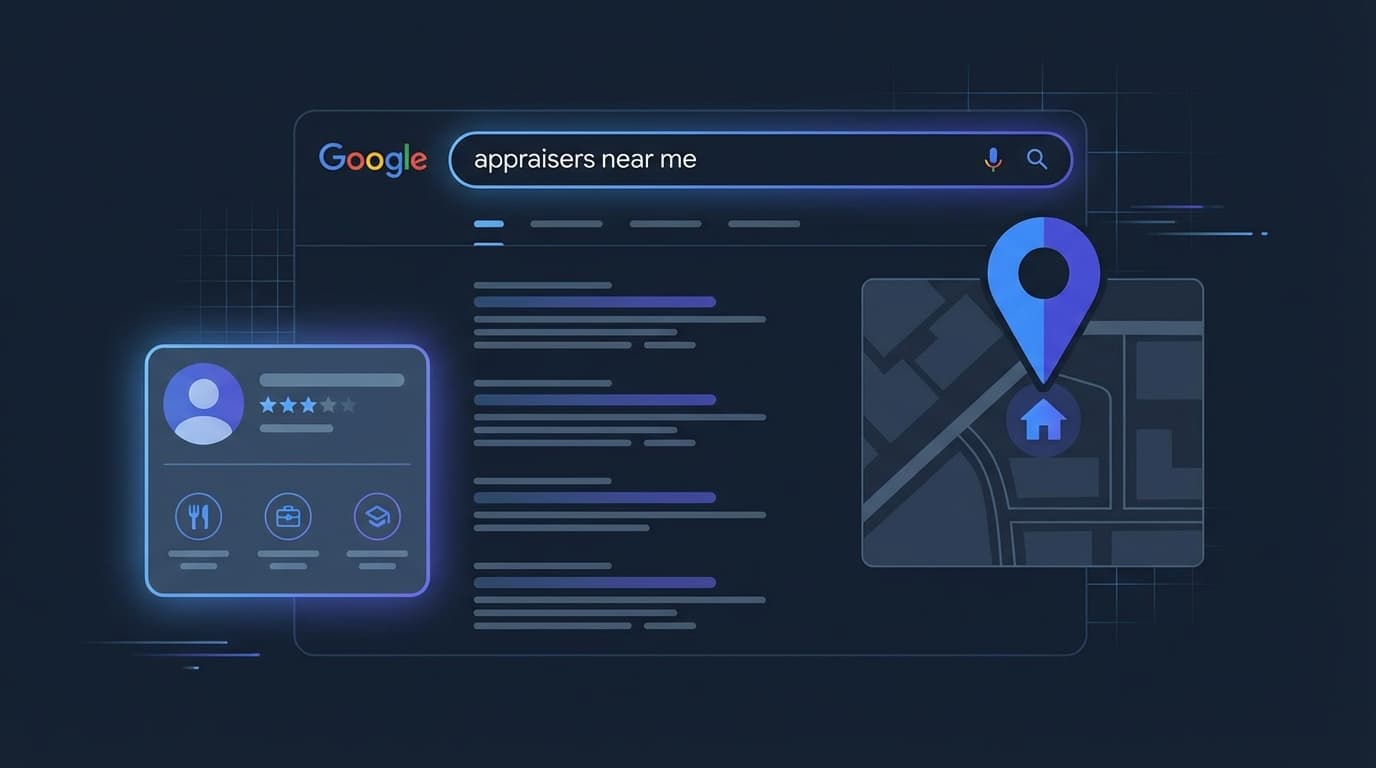
How to Get Found on Google as a Real Estate Appraiser
Try this right now. Open Google on your phone and search "estate appraiser [your city]." Then search "divorce appraisal [your county]." Then "home appraisal near me."
Are you on the first page for any of those searches?
If you're like most appraisers I work with, you're not. And that means every day, potential private clients in your market are searching for exactly the service you provide and finding someone else.
After building over 300 appraiser websites, I can tell you the pattern is almost always the same. The appraiser is skilled, experienced, and fully capable of doing estate, divorce, and private work. But their online presence either doesn't exist, doesn't mention those services, or is buried so far down in search results that nobody finds it.
The good news: fixing this isn't complicated. It doesn't require becoming an SEO expert. And the appraiser who does it first in your market wins - because most of your competitors never will.
Google Business Profile: The Single Most Important Thing You Can Do
Your Google Business Profile (formerly Google My Business) is what shows up in the map results and the local listings when someone searches for an appraiser in your area. It's the first thing most people see. And for many appraisers, it's either unclaimed, incomplete, or optimized for lender work instead of private clients.
Here's what to do. This takes about 2 hours total and it's the highest-ROI marketing action any appraiser can take.
Claim your listing at business.google.com. If you already have one, verify it's active and that you have access.
Add non-lender services explicitly. This is the step most appraisers miss. In the "Services" section, add: Estate Appraisal, Probate Appraisal, Divorce Appraisal, Pre-Listing Appraisal, Tax Appeal Appraisal, Private Party Appraisal. Google uses these service categories to decide when to show your listing. If "estate appraisal" isn't listed as a service, you won't show up when an attorney searches for it.
Write a description that mentions your specialties. Not "we do residential appraisals." Something like: "Certified residential appraiser serving [County] with estate, divorce, tax appeal, and pre-listing appraisals. [X] years of experience. Direct communication. Court-ready documentation."
Upload real photos. Not stock images. Photos of you at a property, your truck, your inspection equipment, an exterior of a property you've appraised. Google favors listings with 10+ photos. Most appraiser listings have zero.
Get Google reviews that mention specific services. A review that says "Great appraiser" is fine. A review that says "Used them for our estate appraisal, delivered a thorough report in 5 days" is dramatically better for SEO. When you complete a non-lender appraisal, ask the client: "Would you mind leaving a Google review? If you mention the type of appraisal, it really helps other people in similar situations find us."
Five reviews mentioning estate, divorce, or private work will move you ahead of most competitors in your market. Because most of them have zero reviews mentioning non-lender services.
What Private Clients Actually Search For
This matters because it determines what words should be on your website and Google listing. The searches that lead to non-lender work look like this:
- "estate appraiser [city]"
- "divorce appraisal [county]"
- "home appraisal for probate"
- "how much does an estate appraisal cost"
- "real estate appraiser near me"
- "pre-listing appraisal [city]"
- "property appraisal for tax appeal"
- "date of death appraisal"
If none of these phrases appear on your website or Google listing, Google has no reason to show you in those results. You're invisible to the exact clients you want to attract.
The fix is straightforward: use these phrases naturally on your website and in your Google Business Profile. Not stuffed into every sentence. Just present. A services page that says "We provide estate and probate appraisals for [County] attorneys" contains multiple search phrases naturally.
Your Website: What It Actually Needs
After building 300+ appraiser websites, I can tell you the ones that generate private client inquiries share five characteristics. The ones that don't are missing at least two.
A homepage that says what you do and where. "Certified Residential Appraiser serving [County]. Estate, divorce, tax appeal, and pre-listing appraisals." This needs to be visible immediately - not buried below the fold.
Dedicated pages for each non-lender service. Not one generic "services" page. Individual pages for estate appraisals, divorce appraisals, tax appeal appraisals, and pre-listing appraisals. Each page should explain the service, who it's for, what's included, and how to get started. Google treats each page as a separate ranking opportunity. One page gives you one chance to rank. Four pages give you four.
Your credentials prominently displayed. License number, certifications, years of experience, service area. Attorneys checking your website want to verify you're qualified before they call. Make it easy to find.
A way to contact you that doesn't require a phone call. A contact form at minimum. An online quote form is better - when an attorney finds you at 9pm while prepping for a case, they want to submit a request right then, not wait until business hours.
Google reviews embedded or linked. Social proof from other clients - especially attorneys and estate work - validates your credibility.
What you don't need: a blog (unless you have time to maintain it), social media links, a generic stock photo of a suburban house, or a paragraph about how you're "passionate about real estate." Clients don't care about your passion. They care about whether you can deliver a defensible report on time.
The Reviews Strategy
Google reviews are the single biggest factor in local search ranking after your basic profile is set up. More reviews, especially recent ones with relevant keywords, push you higher in search results.
Here's the approach that works without being pushy.
After delivering a non-lender appraisal, send a brief follow-up email:
"Hi [Name], glad we could help with the [estate/divorce/pre-listing] appraisal for [property address]. If you're satisfied with the report, would you consider leaving a brief Google review? It really helps people in similar situations find qualified appraisers. Here's the link: [your Google review link]."
You can find your direct review link in your Google Business Profile dashboard. Most clients who had a good experience will leave a review if you make it easy.
The goal: 3-5 new reviews per quarter. Within a year, you'll have 15-20 reviews - more than nearly any appraiser in your market.
What "Winning" Looks Like on Google
In most mid-size markets, the bar for ranking well as an appraiser is surprisingly low. Your competition isn't Amazon or WebMD. It's other local appraisers - most of whom have unclaimed Google Business Profiles, no website, and zero reviews mentioning non-lender work.
If you have a claimed Google Business Profile with non-lender services listed, a website with dedicated service pages, and 10+ reviews mentioning estate, divorce, or private work, you're likely on the first page for most relevant searches in your market. Not because you're an SEO expert. Because you're the only appraiser who showed up.
That's the competitive reality. In a market where most appraisers are invisible online, basic visibility wins.
For a done-for-you approach, this is one of the things I've spent a decade building through Next Level Pro - professional appraiser websites with non-lender service pages, Google Business Profile optimization, and automated review collection. But even without outside help, the steps above will dramatically improve your visibility within 30-60 days.
Related Articles:

Jon Barrett
Jon Barrett is the founder of Appraiser Machine and has spent over a decade working with independent appraisers. He's built 300+ appraiser websites, co-led a national appraiser mastermind group, and talked with hundreds of appraisers about what's actually working in their practices. He built Appraiser Machine because the operations side of running an appraisal practice was still stuck in spreadsheets and duct tape - and appraisers deserved better.