
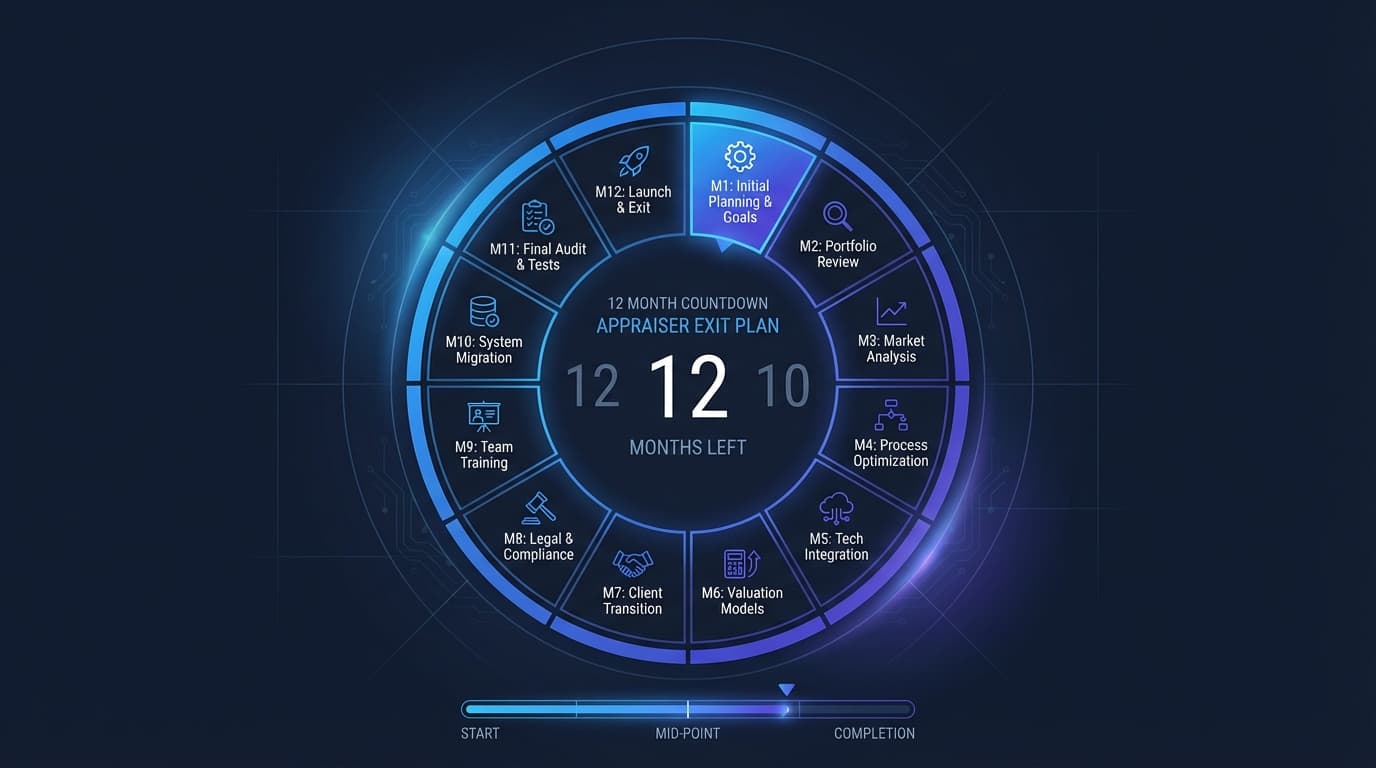
The Appraiser's 12-Month Exit Countdown: What to Do Each Quarter
You've decided you want to sell your practice someday. Maybe in a year. Maybe in three. Maybe you're just starting to think about what retirement looks like.
The problem is that "someday" doesn't build sellable value. Actions do. And the actions have a sequence - you can't list your practice for sale if you don't have clean financials, you can't show clean financials if you haven't been tracking them, and you can't show transferable client relationships if you haven't documented them.
This article is the quarter-by-quarter plan for the 12 months before you want your practice to be sale-ready. If your timeline is longer than 12 months, start earlier and move slower. If it's shorter, prioritize the highest-impact items and accept that some value-building won't be complete.
The underlying principle: every quarter converts personal goodwill (value that lives in your head) to enterprise goodwill (value that transfers to a buyer). (Full framework here.)
Quarter 1 (Months 1-3): Build the Foundation
This quarter is about documentation. Getting what's in your head into systems a buyer can see, verify, and use.
Move every client into a searchable database. Every attorney, homeowner, CPA, AMC contact, real estate agent, and anyone else who has ever sent you work. Name, phone, email, type of work, fee history, last order date. If this information currently lives in your phone, your email, and your memory, it needs to live in one searchable system by the end of month 3.
This is the single most impactful thing you can do. A buyer looking at "I have relationships with attorneys" sees nothing verifiable. A buyer looking at "here are 52 attorney contacts who sent 247 orders over 3 years" sees a transferable client base.
Clean up your financial records. Open QuickBooks (or whatever you use). Reconcile the last 12 months. Make sure every invoice is entered, every payment recorded, and revenue is categorized by client type (AMC lender, estate, divorce, tax appeal, pre-listing, other private). If your books are a mess, hire a bookkeeper for one day to help you catch up. This investment pays for itself many times over when a buyer does due diligence.
Claim and optimize your Google Business Profile. If you haven't already, claim it. Add your service areas, your services (estate, divorce, tax appeal by name), your hours, your phone number, and photos. Start requesting reviews from every private client you deliver to this quarter. (Full review strategy.)
Assess your website. Does it exist? Does it rank? Does it list non-lender services? Does it have a quote form? If the answer to any of these is no, getting a professional website built is a Quarter 1 priority. A website takes 60-90 days to start building search authority. Every month you delay is a month of compounding you lose. (Why your website matters.)
Quarter 2 (Months 4-6): Build Revenue Diversity
This quarter is about reducing your dependence on revenue sources that don't transfer - and building the ones that do.
Execute the 90-Day Plan for private clients. Send introduction letters to estate attorneys and divorce lawyers. Follow up systematically. Build 3-5 attorney relationships that produce regular orders. (Full plan here.)
Every private client relationship you build in this quarter is a transferable revenue source. Every attorney who starts sending you estate work is an attorney a buyer will inherit. The target: move from wherever you are today toward 25-30% non-AMC revenue by the end of the year.
Document your fee schedule. Write down what you charge for each service type. Not what you "usually" charge. A written fee schedule that a buyer can adopt on day one. Include fee ranges for complex properties, travel surcharges for distant inspections, and any rush fee structures.
Put your operations in a platform. Orders, routes, mileage, invoicing, client records - in one system. Not because you need it (you've operated without it for years) but because a buyer needs it. The system IS the enterprise goodwill. A buyer can't take over "how you do things in your head." They can take over a platform with documented workflows. (Appraiser Machine was designed for this.)
Quarter 3 (Months 7-9): Optimize and Measure
This quarter is about demonstrating that the practice runs on systems, not just on you.
Track everything for 90 days. Revenue by client type. Turn times. Fee averages. Mileage. Payment cycles. Client acquisition sources. These 90 days of clean data become the evidence a buyer uses to evaluate the practice. "I usually make about $15,000 a month" is not a sales pitch. "Here's 90 days of documented revenue averaging $16,200/month, with 32% from private clients at a $625 average fee" is.
Accumulate Google reviews. By now, if you've been requesting reviews with every private delivery since Quarter 1, you should have 10-20 reviews. Continue. The review count and recency are visible signals that the practice has an active, growing reputation that's independent of who owns it.
Test the "remove yourself" question. For one week, imagine you're the buyer. Walk through your practice's operations as if you were seeing them for the first time. Could you find a client's phone number without asking anyone? Could you see which orders are in progress? Could you generate an invoice? Could you verify last month's revenue? Wherever the answer is "no," that's a gap in enterprise goodwill that needs closing.
If you have a team: document the team structure. Who does what. How orders are assigned. What the QC process looks like. What each contractor is paid and how. Contractor agreements. A buyer isn't just buying your client list - they're potentially buying a functioning team. Documented team operations are a major value driver. (Team management systems.)
Quarter 4 (Months 10-12): Prepare for Market
This quarter is about packaging what you've built into something a buyer can evaluate.
Compile your practice summary. One document that contains: revenue for the past 3 years (by client type), client database summary (number of active clients by type), operational systems overview, website analytics (traffic, lead volume, Google reviews), team structure (if applicable), and service area map. This is the document a buyer or broker will use to evaluate your practice.
Get a valuation estimate. Professional service practices typically sell for a percentage of annual gross revenue — often cited as 25-75% depending on transferability. The exact number depends on the transferable value. With a year of enterprise goodwill building behind you - documented clients, growing Google presence, clean financials, operational systems, non-AMC revenue - you're positioned for the higher end of that range.
Identify potential buyers. The most likely buyers for an appraisal practice: younger appraisers in your market looking to accelerate their business, small firms looking to expand their geographic coverage, trainees who want to launch their own practice with an established client base. (Full buyer guide.)
Plan the transition. Most practice sales include a 3-6 month transition period where the seller introduces the buyer to key clients, transfers relationships, and ensures continuity. The smoother this transition, the higher the sale price - because the buyer has confidence that clients will stay.
The Compounding Effect
Notice how each quarter builds on the previous one. You can't track revenue by client type (Quarter 3) if you haven't set up your financial records (Quarter 1). You can't show private client revenue (Quarter 3) if you haven't built attorney relationships (Quarter 2). You can't present a practice summary (Quarter 4) if you haven't been documenting all year.
This is why exit planning can't be crammed into the last month. Every month of the countdown produces compounding value that makes the practice more attractive, more verifiable, and more sellable.
And here's the part nobody talks about: every action on this list also makes your practice better to own right now. Clean financials help you make better decisions. Documented clients prevent relationships from falling through cracks. Operational systems take routine admin off your plate. Non-AMC revenue pays better and faster.
The exit countdown doesn't just build a practice that's worth selling. It builds a practice that's worth running.
Related Articles:

Jon Barrett
Jon Barrett is the founder of Appraiser Machine and has spent over a decade working with independent appraisers. He's built 300+ appraiser websites, co-led a national appraiser mastermind group, and talked with hundreds of appraisers about what's actually working in their practices. He built Appraiser Machine because the operations side of running an appraisal practice was still stuck in spreadsheets and duct tape - and appraisers deserved better.